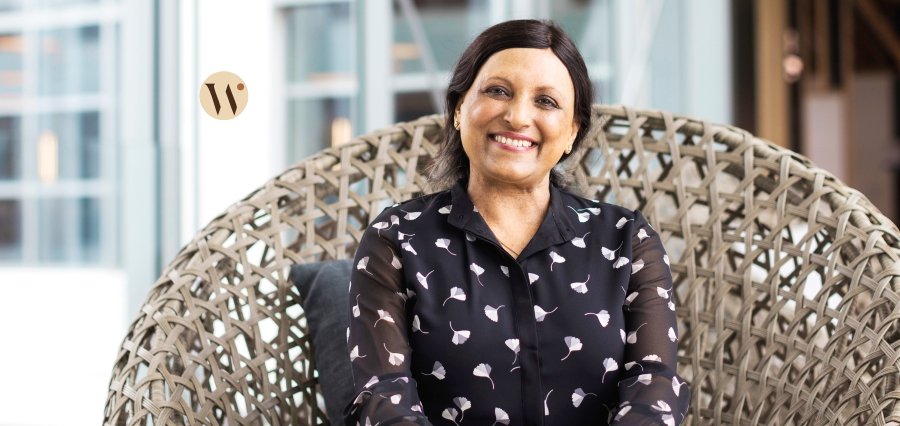
On most mornings, before the emails and the strategy sessions and the decisions that will influence millions of customers, Rathi Murthy starts in silence.
Twenty minutes of breathwork and meditation. No screens. No notifications. Just a deliberate reset.
“In technology there is always pressure to move faster,” she says. “The art of living is about harmony between ambition and presence. If I am not centered, I cannot ask my teams to be.”
It is an unusual starting point for a leader whose world revolves around cloud infrastructure, artificial intelligence and real time banking. Yet this quiet discipline has become the throughline in her life. It allows her to lead at scale without losing her sense of self.
Murthy is the Chief Technology Officer at Varo Bank, the first nationally chartered, all digital consumer bank in the United States. She has held senior roles at Expedia Group, Verizon, Gap Inc., American Express, Yahoo, eBay and WebMD. She sits on the board of PagerDuty, is an active angel investor and teaches the Art of Living, bringing breathwork and mindfulness into rooms that are more accustomed to metrics than meditation.
Her résumé is impressive. Her impact is larger still.
Roots in Constraint, Vision in Scale
Murthy’s leadership journey begins in India, in a world where resources were limited and improvisation was not a buzzword but a survival skill.
“Growing up in India taught me resilience and adaptability,” she says. “When you come from a background where resources are constrained, you learn to innovate creatively. That perspective has stayed with me my entire career.”
In one of her early computer science classes, there were only a handful of women in a lecture hall of nearly one hundred students. Later, as she moved into professional roles, the pattern repeated. In many meeting rooms, she was the only woman present and often the only woman of color.
The challenge was not just technical. It was psychological.
“The unspoken question was whether I belonged there at all,” she recalls. “I had to learn to trust my voice in rooms where I was outnumbered.”
She did not answer that question by trying to be louder. She answered it by being clearer.
“I focused on clarity, persistence and empathy. My contributions had to be data driven and solution oriented. Leadership is not about being the loudest voice. It is about creating an environment where every voice, especially underrepresented ones, is heard and valued.”
That conviction would define her leadership style long before she had the title to match it.
Discovering the Power of Transformation
Rathi Murthy began her career as a software engineer, immersed in code and debugging. She loved the precision of it, but she was equally drawn to a different kind of question: Why are we building this? How does it change someone’s experience?
That curiosity pulled her toward leadership.
At Yahoo, she found herself leading what she describes as a struggling initiative. The Yahoo Open Social project was late to market and under pressure. Partnering closely with the lead engineer, she helped turn it around and launch successfully.
“That experience energized me,” she says. “I realized I thrive on transformation. I like taking something that is not working, aligning teams around a clear mission, and making it faster, smarter and better.”
She carried that mindset to each subsequent role. At Metreo, she built a strong engineering foundation in a startup environment. At eBay, she began to scale this transformation mindset in a global commerce platform. At American Express, she joined an accelerated leadership program under the CEO, sharpening the skills required to lead at scale.
Later, at Expedia Group, she was asked to unify twenty one separate platforms across more than fifty locations into one seamless travel platform. It was the kind of challenge she gravitates toward.
“We had to bring twenty one brands together behind a single mission,” she says. “That kind of alignment does not happen by accident. It requires vision, clear metrics and a lot of listening.”
While at Expedia she also helped launch Romie, a generative AI powered travel assistant that blends concierge, personal assistant and travel agent. It represented not just a new product, but a new way of thinking about how people plan and experience travel.
“What keeps me at the cutting edge is curiosity,” she says. “I invest time with startups, investors and peers. I keep learning. Recently I have been deepening my expertise in AI through programs at MIT. What you master today will not automatically carry you into tomorrow.”
From Faster Payments to Fairer Systems
The idea that technology could be a force for financial empowerment, not just efficiency, crystallized for Rathi Murthy during her time at American Express.
“At American Express I saw how digital tools could reshape financial experiences for millions,” she says. “I met customers who, through mobile access, were able to build credit histories for the first time. That opened doors that had been closed.”
For her, that was a turning point.
“It is not enough for systems to work faster,” she says. “They must work fairer. That belief has become foundational.”
It is one of the reasons Varo appealed to her. Varo is built entirely in the cloud and holds a national bank charter. That unusual combination gives it a rare opportunity: to design a bank built for the realities of modern life rather than retrofit digital tools onto legacy systems.
“We are not just digitizing banking,” Rathi Murthy says. “We are trying to reshape financial access. Our platform is designed so that gig workers, immigrants and people without long financial histories can participate in mainstream banking.”
From simplified onboarding to mobile first experiences, the aim is to make financial tools easier to use and easier to access. She sees the next wave of innovation in the intersection of artificial intelligence and personalization.
“Financial literacy has often been delivered as one size fits all education,” she says. “It does not resonate with diverse realities. With AI, we can provide contextual and real time guidance. That might be a nudge to save when a paycheck hits, an alert when spending patterns change or content in a local language, combined with elements of gamification. Over the next few years, technology will move from offering products to acting more like a coach or partner, guiding people through decisions that build long term financial resilience.”
Culture and Code, in Equal Measure
Murthy’s philosophy of leadership is rooted in a conviction that high performance and psychological safety are not in conflict. In her view, they rely on each other.
“People do their best work when they feel safe to take risks, share ideas and learn from failures,” she says. “High performance without psychological safety is fragile. It does not last.”
To cultivate that environment, she emphasizes transparency about both challenges and opportunities. She encourages open debate, rewards collaboration and keeps the larger mission visible.
“I measure success not only by metrics but also by how well we have built a culture of mutual trust,” she says. “Some of our boldest technology choices succeed because teams trust one another and feel empowered to take on high stakes challenges together.”
Her focus on the human side of transformation is informed by experience. In one previous role, she led a large scale replatforming initiative that initially stumbled.
“Technically the solution worked,” she recalls. “But adoption lagged because we had not brought teams along. That experience reinforced that transformation is as much about culture as code. No matter how elegant the technology, its impact depends on human adoption, and adoption requires ownership, not just direction.”
Today she holds regular forums where teams can voice concerns, invests in reskilling so employees feel equipped for what comes next, and celebrates small wins along the way. Change, she says, is not a single leap. It is a series of steps taken together.
Conscious Leadership in Practice
For Rathi Murthy, the Art of Living did not enter her life as a hobby. It arrived at a breaking point.
“There was a time in my career when everything looked successful from the outside, but inside I was exhausted,” she says. “I was leading complex teams, constantly in motion, but I was not fully present.”
She took an Art of Living course out of curiosity. The effect was immediate.
“Breathwork and meditation gave me tools to reduce stress and increase clarity,” she says. “It improved my focus, my emotional balance and my ability to show up for my teams.”
She eventually became a certified Art of Living teacher so she could share the practice with others, particularly people in demanding roles.
“These tools help people regulate their energy and emotions,” she explains. “In leadership, that steadiness can shift entire cultures.”
Her version of conscious leadership is not abstract. It shows up in small, consistent habits. She starts her mornings with meditation. She eats simply and pays attention to how food and movement influence her mental state. She sets aside time for family, travel and reflection. At work, she models presence by putting devices away during one to one meetings and creating moments of pause in high stakes environments.
“If I notice I am carrying tension into a room or making decisions from a place of fear or exhaustion, I pause,” she says. “That pause is powerful. It allows you to reset, reconnect to your purpose and lead with integrity.”
Security, Trust and the Modern Bank
Varo’s fully digital model creates both opportunity and responsibility. There are no physical branches. The bank exists entirely through apps, websites and the systems that support them.
“Being all digital means our entire operation sits on modern infrastructure,” she says. “It also means our attack surface is dynamic and always evolving.”
Murthy thinks about security not as a set of controls in the background, but as a core part of the brand promise. From real time threat detection and anomaly monitoring to strong authentication and secure by design development practices, her teams are building systems that must work at scale without adding friction to the customer experience.
“In financial services you cannot afford to move fast and break things,” she says. “You have to move thoughtfully and build trust into every layer.”
She evaluates new technologies using three criteria: readiness, relevance and responsibility. Is the technology mature enough to scale securely? Does it address a genuine customer need rather than chasing a trend? Can it be implemented ethically, especially when dealing with sensitive data?
“With AI we are adopting it aggressively in areas such as fraud detection and personalization,” she notes. “We are moving more carefully in areas where the risk of bias is higher. The goal is not to be first. The goal is to be trusted, and to deliver innovation that is reliable, inclusive and sustainable.”
Inclusion as Structure, Not Slogan
As a visible woman leader in a field where women, especially those from minority groups, remain underrepresented, Murthy speaks frankly about the changes she would like to see in the industry.
“The industry needs to move beyond token diversity metrics to structural inclusion,” she says. “That means redesigning recruitment pipelines, mentorship models and promotion practices so that equity is embedded, not episodic.”
She also believes leadership itself must become more sustainable.
“We have to normalize boundaries and celebrate not just outcomes but how leaders model well being,” she says. “Inclusivity and sustainability are not add ons. They are preconditions for innovation. A diverse team builds better products, and a well supported leader builds more resilient organizations.”
For women coming into technology today, she offers a mix of practical and personal advice. Treat your career like a product. Understand the impact you want to have. Learn the language of business. Build horizontal relationships, not only vertical ones. And above all, do not wait until you feel perfectly prepared.
“Early in my career I sometimes hesitated to raise my hand unless I felt one hundred and ten percent ready,” she says. “I have learned that readiness often comes after you step into the challenge, not before. Take risks, trust your abilities and do not internalize setbacks as permanent limitations. Confidence is built in community, not in isolation.”
Authenticity, she adds, is not a liability but a strength.
“Do not trade your authenticity for authority,” she says. “Teams respond to clarity, trust and consistency, not performance. Lead with intention, not imitation.”
A Legacy of Access and Inner Clarity
Awards and titles have followed Murthy throughout her career. She has been named one of the Top 100 Executive Women in Tech to Watch and recognized as a Most Influential Woman in Payments. She invests in mission driven startups and serves on the board of PagerDuty, where she is excited about the potential of intelligent automation and AIOps to improve reliability and free teams for higher value work.
Yet when she talks about legacy, she returns to the same themes: access, trust, inner clarity.
Her work at Varo is about making financial tools more inclusive and humane. Her teaching and advocacy are about helping people navigate high pressure environments without losing themselves. Her interest in AI is grounded in a desire to ensure that the systems that will shape the next era are designed with diversity and ethics in mind.
“A consciously led future is one where we do not just ask, ‘Can we build this’ but also, ‘Should we’ and ‘Who does this serve,’” she says. “Innovation has to be guided by empathy, inclusion and long term thinking.”
In many ways, that future begins in the same place her day does: a few quiet minutes, an intentional breath, a reminder that clarity on the inside is what allows transformation on the outside.
“Technology will keep accelerating,” she says. “What matters is whether we can keep our values at the center as we build. That is the work I care about most.”